
Are You Ready for MTD?
First Quarterly Deadline Is 7 August 2026
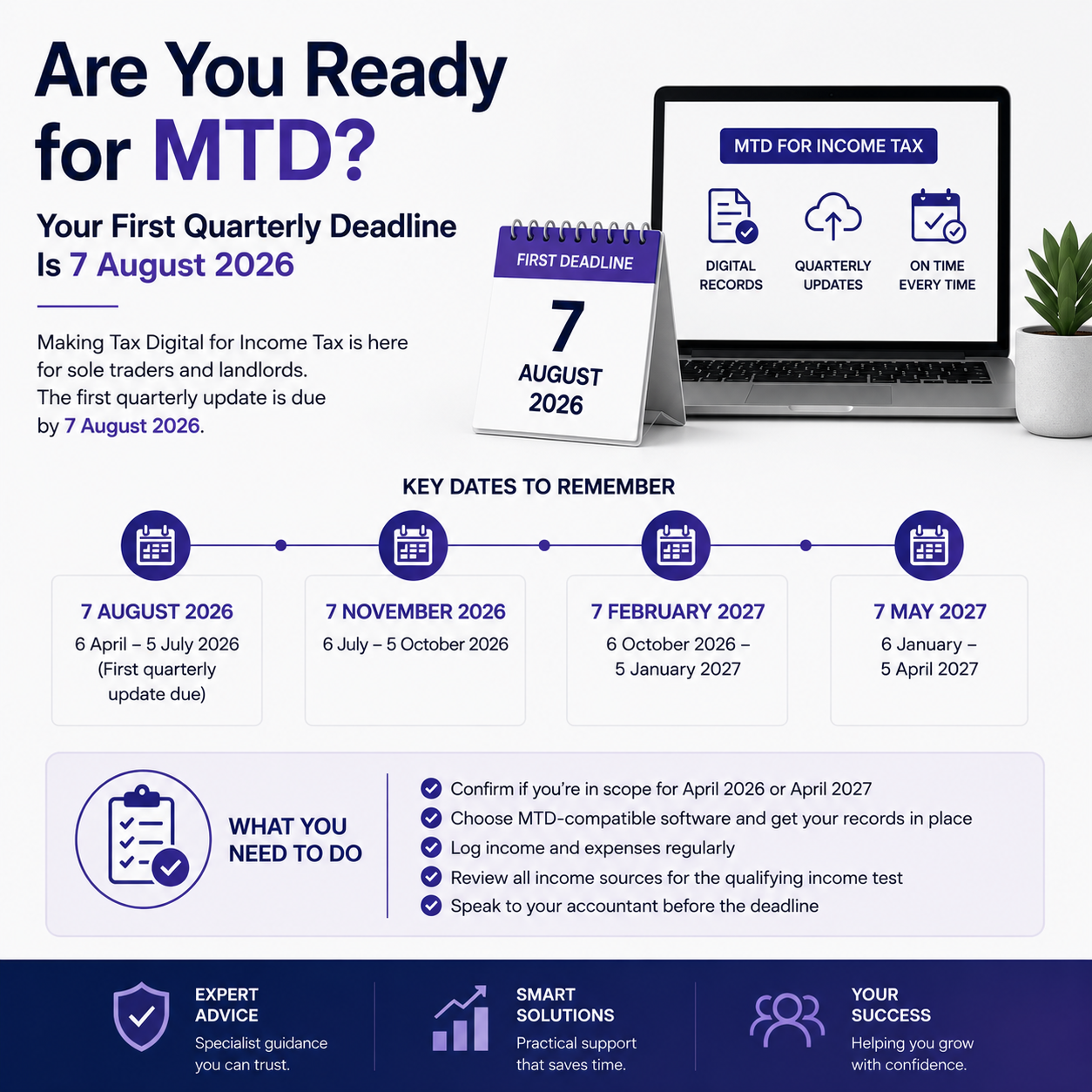
If you're a sole trader or landlord, Making Tax Digital for Income Tax stopped being a future problem back in April. It's a live one now. The first quarterly deadline lands on 7 August 2026, and if you haven't set up digital record keeping yet, this is the week to sort it, not the week before it's due.
Who this actually affects
From 6 April 2026, HMRC requires sole traders and landlords with qualifying income over £50,000 to keep digital records and submit quarterly updates through MTD-compatible software, instead of filing one Self Assessment return a year. If your combined trading and property income sits below that threshold for now, you'll be brought in from April 2027 at the £30,000 mark. Either way, this is coming for most people running a business or letting property outside a limited company.
What's actually due on 7 August
Your first quarterly update covers income and expenses from 6 April to 5 July 2026, and it's due by 7 August 2026. Three more follow through the year, on 7 November, 7 February and 7 May, each covering the three months before it. These aren't tax returns. They're a running record of what's come in and gone out, submitted through approved software so HMRC can see your position build up through the year instead of all at once in January.
The tax you owe is still calculated and paid the way it always has been, by 31 January the following year. The quarterly updates don't change what you pay, only how often you report.
The grace period, and why it isn't a reason to relax
HMRC has confirmed it won't issue penalty points for late quarterly updates in this first year, 2026/27. That's welcome, but it only covers the quarterly submissions, not the final tax return due by 31 January 2028, and it won't last beyond year one. Treat the grace period as breathing room to get your process right, not as permission to leave this until next spring.
What to do before 7 August
• Confirm whether your qualifying income puts you in scope for April 2026 or April 2027, so you know which deadline is actually yours.
• Choose MTD-compatible software and get your bookkeeping into it now, rather than trying to reconstruct three months of records the week before the deadline.
• Set up a simple habit for logging income and expenses as they happen. Weekly is enough to make each quarterly update a five-minute task rather than a scramble.
• If you have multiple income sources, such as a trade and a rental property, check how they're reported together under the qualifying income test.
• Talk to your accountant before the deadline, not after it, so any gaps in your records can be fixed while there's still time.
The bottom line
MTD for Income Tax is the biggest change to how sole traders and landlords report tax since Self Assessment began. The first deadline is close enough now that “I'll get to it” isn't a plan. If you're in scope and not yet set up on digital record keeping, that's the one thing worth doing this week.
If you're not sure whether you're affected, or you want help getting your records MTD-ready before 7 August, get in touch and we'll walk through it with you.
At Highwoods Group we help agency owners build businesses that fund the whole wheel, not just one slice of it. Visit highwoodsgroup.co.uk to start the conversation.
#CreativeAgencies #AgencyGrowth #StrategicFinance #Profitability #BusinessLeadership #LondonBusiness #Shoreditch