
Stop Buying Loyalty
Why EMI schemes outperform salary for agency talent retention
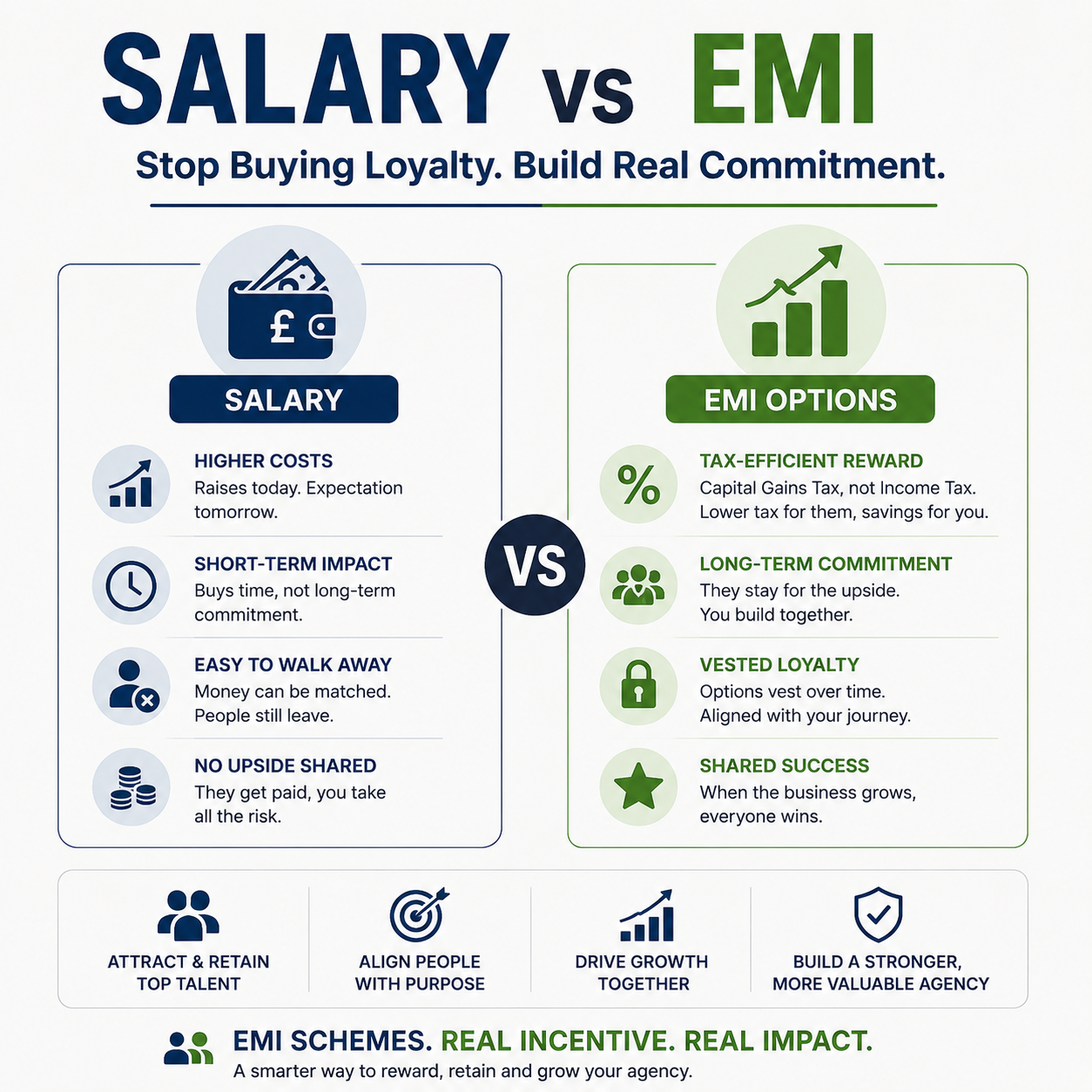
The creative industry has a retention problem. Senior designers leave for competitors. Account directors get poached. Strategists who took years to develop hand in their notice for a role that pays a few thousand pounds more.
The instinctive response is to match the offer, raise the base, or throw in a bigger bonus. Sometimes it works. More often, it buys six months before the same conversation happens again.
What most agency owners do not realise is that there is a more effective tool available, one that aligns the people you most want to keep with the long-term success of the business. It is called an EMI share scheme. And the majority of agencies that would benefit from one have never set one up.
What Agencies Are Getting Wrong
The talent conversation in most agencies is framed entirely around compensation. Who is paying what, who can stretch further, who is willing to match a counter-offer. It is expensive, reactive, and does nothing to change the underlying dynamic.
The problem is not always salary. Often the people who leave are the ones who feel like they are building something for someone else. They put in the hours, grow the accounts, help win the pitches, and watch the value accumulate to the founders. At a certain point, that stops feeling sustainable.
EMI options change that equation. Instead of asking whether you can out-pay the competition, you are offering something most competitors cannot: genuine skin in the game.
What an EMI Scheme Actually Is
Enterprise Management Incentives (EMI) is a government-backed share option scheme designed specifically for smaller businesses. It lets you grant selected employees the right to buy shares in the company at a fixed price, at a future date, usually when a certain event occurs such as a sale, a buyout, or after a vesting period.
The employee does not buy shares today. They hold an option, a right to buy at the price agreed now. If the business grows in value, the gap between that original price and the eventual value is their gain.
The tax treatment is what makes it genuinely powerful. Employees pay Capital Gains Tax on their gain rather than Income Tax and National Insurance. At current rates, that is a significantly lower tax bill. For the employer, there is no employer National Insurance on the gain, and in many cases the company receives a Corporation Tax deduction.
It is one of the most tax-efficient ways to reward and retain key people that exists in the UK tax code.
Who Qualifies
EMI is not available to every business, but most independent agencies will qualify. The main conditions are that the company must be a trading company with gross assets under £30 million, fewer than 250 full-time equivalent employees, and must not be a subsidiary of a larger group.
Individual employees must work at least 25 hours per week, or if less, at least 75 per cent of their working time must be for the company. There are limits on how many options can be granted, currently up to £250,000 worth per employee, with a company-wide limit of £3 million.
HMRC also offers a valuation service, so you can agree the share price upfront and remove uncertainty for both the business and the employee.
Why More Agencies Do Not Use It
The honest answer is that most agency owners simply do not know it exists, or assume it is complicated and expensive to set up. Neither is quite true.
The setup does require legal and tax advice to do properly. The scheme needs to be structured correctly, the options agreement drafted, and HMRC notified within 92 days of the grant. Get that wrong and the tax advantages disappear. But for any agency with the right professional support, it is a straightforward process.
The bigger barrier is mindset. Giving employees a stake in the business feels uncomfortable for some founders, particularly those who built it from scratch and have never thought about ownership in those terms. What is worth understanding is that EMI options are not the same as giving away equity today. The employee only benefits if the business grows. You are not diluting what you have built. You are creating a structure where the people helping you build it have a reason to stay and a reason to care.
The Real Opportunity
For agencies trying to hold onto senior talent in a competitive market, EMI is not a nice-to-have. It is one of the most practical tools available.
It costs less than matching inflated salary demands. It builds loyalty that a pay rise cannot buy. And it aligns the people who matter most to the business with the outcome you are working towards.
If you have never looked at whether your agency qualifies, or you have considered it and put it in the too-complicated pile, it is worth revisiting. The agencies that get this right tend to find that the retention conversation becomes a lot simpler.
Highwoods Group advises agencies across the UK on EMI scheme setup, share valuations, and employee incentive planning. If you want to understand whether it is right for your business, visit highwoodsgroup.co.uk
#CreativeAgencies #AgencyGrowth #StrategicFinance #Profitability #BusinessLeadership #LondonBusiness #Shoreditch