
Is Your Agency Busy or Truly Productive?
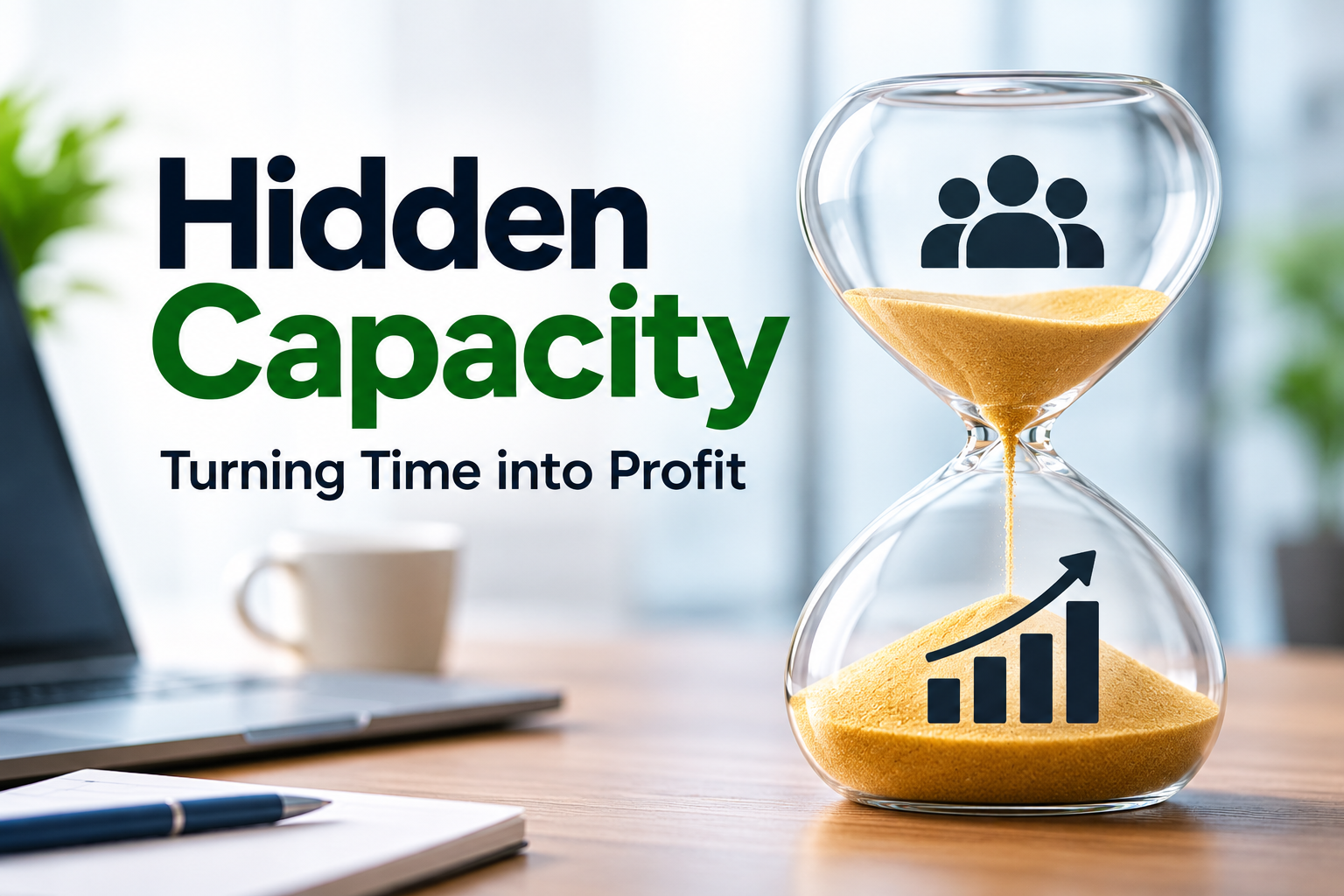
A busy agency is not necessarily a profitable one.
Your team may be working long hours, projects may be progressing and revenue may be increasing. Yet profitability remains under pressure, deadlines are missed and additional freelancers are needed to meet client commitments.
The underlying problem may not be insufficient demand or a shortage of employees. It may be how effectively your agency uses its existing capacity.
For agency leaders, understanding capacity is essential to improving productivity, protecting margins and achieving sustainable growth.
1. Understanding Your Agency's Capacity
Capacity represents the time, skills and resources available to deliver services.
However, there is an important distinction between available hours, productive hours and profitable hours.
Consider an agency employing ten people, each contracted to work 160 hours per month.
Capacity measureMonthly hoursTotal contracted capacity1,600Client delivery time at 60% utilisation960Other activities640
The remaining 640 hours are not necessarily wasted. They may include essential management, training, business development, administration and employee leave.
However, excessive meetings, inefficient workflows, repeated revisions and poor project planning can consume valuable resources without generating sufficient commercial returns.
The objective is not to eliminate every nonbillable hour. It is to understand whether each activity contributes to the agency's long term performance.
2. The Financial Cost of Inefficiency
Suppose an agency generates £120,000 in monthly revenue from 960 client delivery hours.
This represents an average revenue recovery of £125 per delivery hour.
If improved processes release an additional 160 hours of capacity, those hours could potentially support £20,000 in additional monthly revenue at the same recovery rate.
That represents £240,000 in potential annual revenue capacity.
However, this is an illustration of opportunity, not guaranteed income. The agency must have sufficient client demand, appropriate pricing and the ability to convert additional capacity into profitable work.
Alternatively, the agency could use the released capacity to reduce freelance expenditure, improve service quality or accommodate future growth without immediately recruiting.
The real financial benefit depends on how the additional capacity is used.
3. Where Agencies Lose Capacity
Several operational weaknesses can reduce productivity and profitability.
Poor project scoping
Unclear briefs, unrealistic deadlines and poorly defined deliverables frequently result in additional work that was never included in the original fee.
Excessive client revisions
Repeated changes can significantly increase delivery costs, particularly when additional time cannot be recovered through revised fees.
Inefficient internal processes
Duplicated tasks, unnecessary meetings and fragmented communication reduce the time available for valuable work.
Poor resource allocation
Assigning senior employees to routine activities or inexperienced employees to complex projects can increase delivery costs and create avoidable delays.
Inadequate capacity forecasting
Without visibility over future workloads, agencies may recruit prematurely, rely excessively on freelancers or struggle to meet deadlines.
These problems rarely appear as individual expenses in the profit and loss account. Instead, their combined impact becomes visible through declining margins and increasing operating costs.
4. Five Measures Every Agency Should Monitor
Financial reporting becomes more valuable when combined with operational performance measures.
Utilisation rate
The proportion of available working time spent delivering client work. Agencies should define available hours consistently and distinguish billable work from essential internal activities.
Revenue recovery
The revenue generated relative to the hours invested in delivering services. This helps identify whether pricing reflects the resources required.
Project profitability
The contribution earned after deducting project delivery costs, including staff time, freelancers and other directly attributable expenditure.
Capacity forecasting
A forward looking assessment of available resources against confirmed projects and expected demand.
Client profitability
The financial contribution generated by each client after considering the cost of servicing the relationship.
Together, these indicators provide a clearer picture of how effectively an agency converts resources into financial performance.
5. Why Higher Utilisation Is Not Always Better
It may seem logical that increasing utilisation will automatically improve profitability.
However, operating continuously at maximum capacity can create unintended consequences.
Employees need time for training, collaboration, innovation and business development. Excessive workloads can increase mistakes, staff turnover and burnout.
A financially successful agency must balance productivity with service quality and employee wellbeing.
The objective should therefore be profitable utilisation rather than maximum utilisation.
This means directing available capacity towards activities that create the greatest commercial value while maintaining sufficient flexibility to respond to changing client demands.
6. Turning Hidden Capacity into Commercial Value
Agency leaders should focus on four practical improvements.
Improve project planning
Establish realistic budgets, clear deliverables, resource requirements and procedures for approving additional work.
Strengthen financial visibility
Monitor actual delivery costs against project budgets and investigate significant differences before they become recurring problems.
Use technology intelligently
Automation, AI and integrated project management systems can reduce repetitive administration and improve workflow efficiency. However, technology investment should be assessed against measurable financial and operational benefits.
Align recruitment with demand
Before increasing headcount, assess existing utilisation, future workloads, employee capabilities and the potential to improve processes.
These actions can strengthen margins without relying entirely on additional revenue.
7. Building Sustainable Capacity
Sustainable growth requires an agency to balance financial performance, operational efficiency and the wellbeing of its people.
Investing in employee development, improving resource allocation and reducing unnecessary work can support stronger profitability and a healthier working environment.
These principles also align with UN Sustainable Development Goal 8, Decent Work and Economic Growth, which promotes productive employment and sustainable economic progress.
For agency leaders, sustainability should be reflected in everyday decisions about recruitment, technology, productivity and financial planning.
The Highwoods Perspective
At Highwoods Group, we believe financial performance and operational effectiveness must work together.
Understanding how your agency uses its time, people and resources helps inform better decisions about pricing, recruitment, investment and growth.
An agency does not necessarily need more employees, more clients or longer working hours to improve profitability.
Sometimes, the greatest opportunity already exists within the business.
Before investing in additional capacity, ask yourself: Are we creating the greatest possible value from the resources we already have?
Because sustainable growth is not simply about doing more work. It is about making the work you do more profitable.
Explore our growth support services today at highwoodsgroup.co.uk.