
Beyond Financial Performance
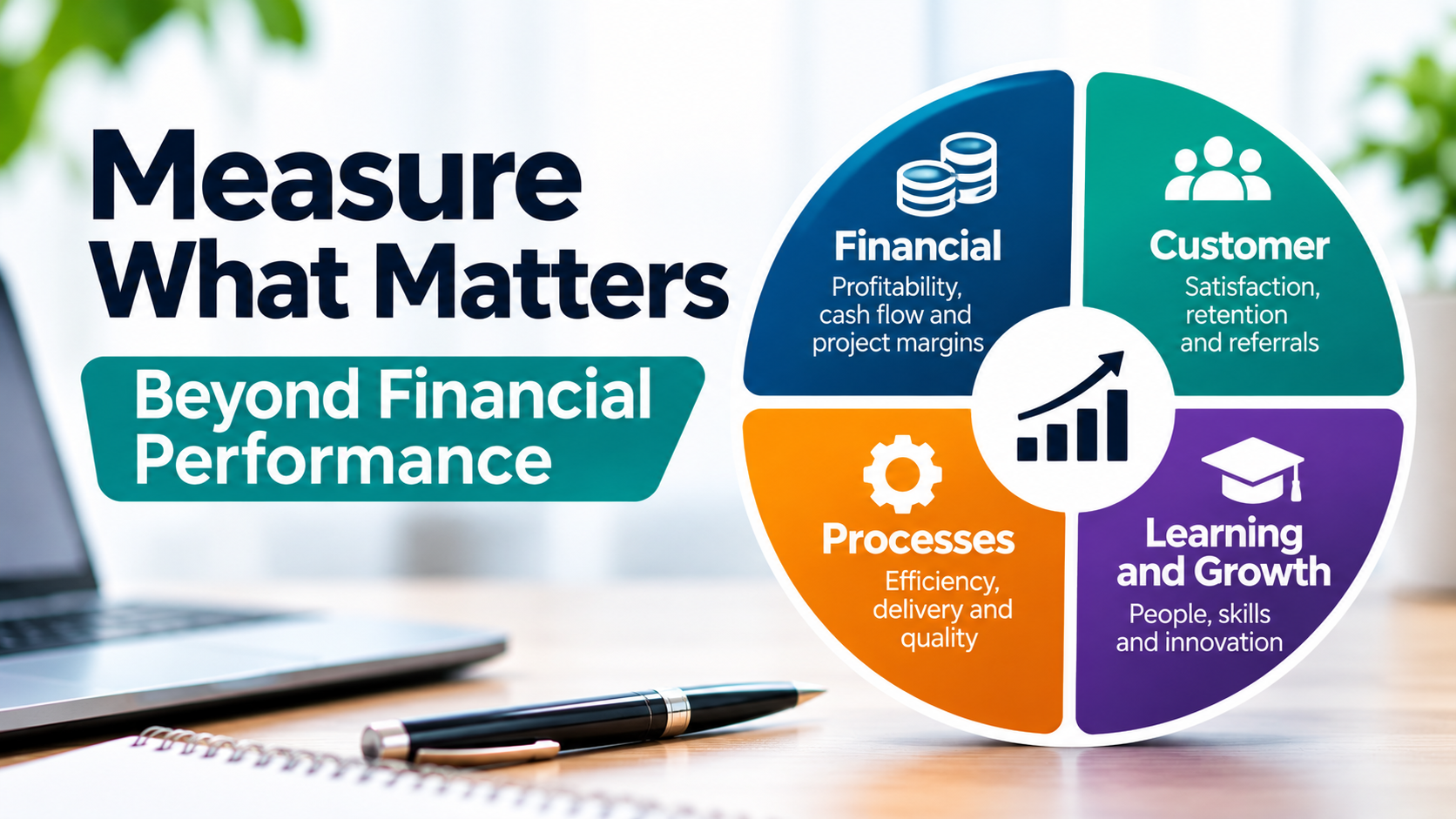
Many agency owners measure business success through revenue, profitability and cash flow. While these indicators are essential, they provide only part of the picture.
Financial results tell you what has already happened. They do not necessarily explain why it happened or what is likely to happen next.
An agency can report healthy profits while experiencing declining client satisfaction, employee disengagement, operational inefficiencies and weakening competitive advantage.
By the time these problems appear in the financial statements, the commercial damage may already have been done.
Effective performance management requires a more balanced approach.
1. Understanding the Balanced Scorecard
Developed by Robert Kaplan and David Norton, the Balanced Scorecard is a strategic management framework that evaluates organisational performance across four interconnected perspectives:
Financial performance
Customer performance
Internal business processes
Learning and growth
Rather than concentrating exclusively on financial outcomes, the framework helps business leaders understand the underlying factors that influence sustainable performance.
2. Financial Performance: Are We Creating Value?
Financial performance remains fundamental to business success. Without sufficient profitability and cash flow, an agency cannot sustain its operations, invest in its people or pursue growth opportunities.
Agency leaders should regularly monitor:
Revenue growth
Gross profit margin
Operating profit margin
Project profitability
Cash flow and working capital
Revenue per employee
Return on investment
However, these measures are predominantly lagging indicators. They reflect the consequences of decisions and activities that have already taken place.
Understanding what drives these results is equally important.
3. Customer Performance: Are We Creating Client Value?
Client relationships are among an agency's most valuable commercial assets.
An agency experiencing strong revenue growth but declining client retention may have an underlying service quality or relationship management problem.
Key performance indicators include:
Client retention rate
Customer satisfaction
Client lifetime value
Client profitability
Referral rates
Client concentration
Winning new clients is important, but retaining profitable existing clients can provide greater financial stability and reduce acquisition costs.
Agency leaders must understand not only how much revenue their clients generate, but also the quality, profitability and sustainability of those relationships.
4. Internal Processes: How Efficiently Do We Deliver?
Operational efficiency directly influences profitability.
Poor project management, excessive revisions, inefficient workflows and inadequate resource allocation can increase delivery costs without generating additional revenue.
Agencies should monitor:
Staff utilisation
Project delivery against budget
On time project completion
Rework hours
Revenue recovery per delivery hour
Quality and error rates
These indicators help identify operational weaknesses before they become significant financial problems.
For example, declining project delivery efficiency may provide an early warning of future margin erosion, even when current revenue remains strong.
5. Learning and Growth: Are We Building Future Capability?
An agency's ability to remain competitive depends on its people, technology, leadership and capacity to innovate.
Businesses that focus exclusively on immediate profitability may underinvest in the capabilities required for future growth.
Important measures include:
Employee retention
Staff engagement
Professional development
Leadership capability
Technology adoption
Innovation and service development
Investment in artificial intelligence, automation and employee development should be assessed against measurable improvements in productivity, service quality and commercial performance.
The objective is not simply to reduce costs. It is to build an organisation capable of creating greater value over time.
6. Building Your Agency's Performance Dashboard
The following illustrates how an agency might translate strategic objectives into measurable performance targets.
PerspectivePerformance indicatorIllustrative targetFinancialOperating profit margin20%FinancialDebtor days30 days or fewerCustomerAnnual client retention90%CustomerClient satisfaction95%Internal processesClient delivery utilisation75%Internal processesProjects delivered on time95%Learning and growthAnnual training per employee40 hoursLearning and growthAnnual employee retention90%
These targets are illustrative rather than industry benchmarks. Each agency should establish appropriate targets based on its business model, historical performance, strategic objectives and available resources.
Every indicator should have a clear definition, an accountable owner and a regular reporting cycle.
7. Connecting Performance to Strategy
The real value of the Balanced Scorecard lies in understanding how different areas of performance influence one another.
Investment in employee development can improve operational efficiency. Better operational efficiency can strengthen service quality. Improved service quality can increase client retention, which can ultimately support stronger profitability and cash flow.
Financial performance is therefore not an isolated objective. It is the outcome of interconnected strategic and operational decisions.
Management should regularly review these relationships, investigate performance variances and take corrective action where necessary.
8. Measuring Sustainable Growth
Sustainable business performance requires a balance between financial success, employee wellbeing, innovation and responsible resource management.
This aligns with two United Nations Sustainable Development Goals:
SDG 8: Decent Work and Economic Growth
Promoting productive employment, employee development and sustainable economic performance.
SDG 9: Industry, Innovation and Infrastructure
Encouraging innovation, technological development and resilient business infrastructure.
By incorporating these principles into performance management, agencies can pursue profitability while building stronger, more adaptable and responsible organisations.
The Highwoods Perspective
At Highwoods Group, we believe management reporting should extend beyond traditional financial statements.
Effective financial leadership involves understanding the relationship between people, processes, customers and profitability.
Through management accounting, strategic advisory and fractional CFO support, we help agency leaders develop greater financial visibility and translate performance information into meaningful commercial decisions.
The objective is not to measure everything. It is to measure what genuinely influences the success of your business.
Are you simply measuring your agency's financial results, or actively managing the factors that determine them?
Because financial performance is the outcome. People, processes and customer relationships are the drivers.
Explore our growth support services today at highwoodsgroup.co.uk.