
Protecting Your Agency's Profit
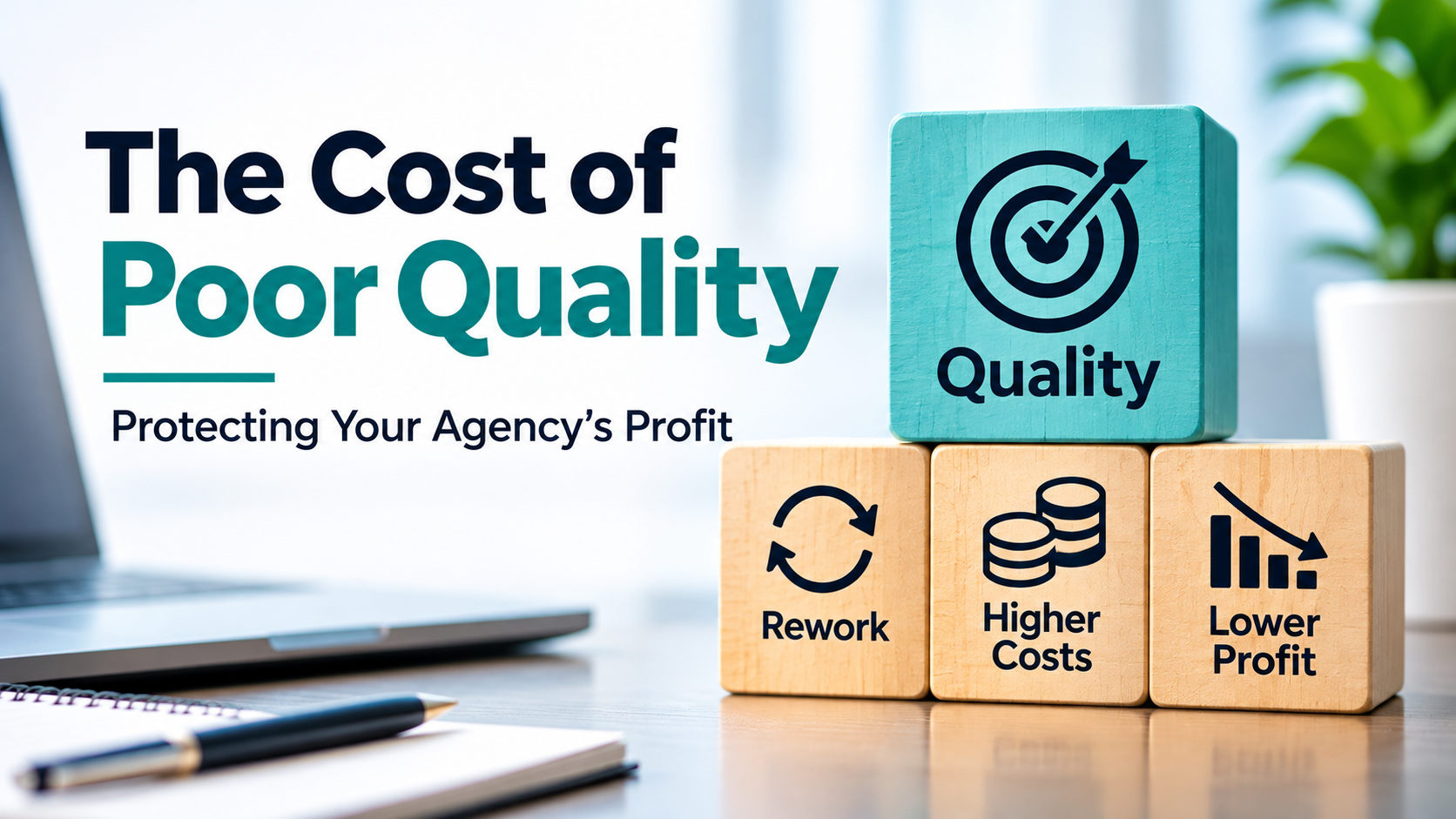
For agencies, profitability is not determined solely by the number of clients secured or the revenue generated. It also depends on how efficiently and consistently services are delivered.
An agency may have talented employees, strong client relationships and a healthy pipeline, yet still experience declining margins.
The underlying problem may be the hidden cost of poor quality.
Incorrect briefs, missed deadlines, repeated revisions, inadequate quality checks and avoidable mistakes all consume valuable resources.
These costs rarely appear separately in management accounts. Instead, they are absorbed into payroll, freelance expenditure and project delivery costs, making their financial impact difficult to identify.
1. Understanding the Cost of Quality
The cost of quality is not simply the amount spent ensuring work meets an acceptable standard. It also includes the financial consequences when that standard is not achieved.
There are four important categories:
Prevention costs: Investment in training, clear processes, project planning and systems designed to prevent errors.
Appraisal costs: The cost of reviewing, testing and checking work before delivery.
Internal failure costs: Resources consumed correcting mistakes identified before work reaches the client.
External failure costs: Additional costs arising after delivery, including complaints, corrective work, refunds and potential client losses.
For agency leaders, the objective is not to eliminate all quality expenditure. It is to find the appropriate balance between preventing problems and paying to correct them.
2. The Financial Impact of Rework
Consider an agency delivering a project worth £20,000.
The original delivery budget is £12,000, leaving an expected contribution of £8,000.
However, unclear requirements, repeated corrections and additional freelance support increase actual delivery costs to £16,000.
Project performanceOriginal budgetActual outcomeRevenue£20,000£20,000Delivery costs£12,000£16,000Project contribution£8,000£4,000Contribution margin40%20%
Although revenue remains unchanged, the project's contribution has fallen by 50%.
The agency must now generate additional profitable work simply to recover the contribution lost through inefficient delivery.
This illustrates why increasing sales without addressing operational weaknesses may fail to improve overall profitability.
3. Where Agencies Experience Quality Failures
Poor client briefs
Incomplete requirements create misunderstandings, unnecessary revisions and delays.
Weak project management
Unclear responsibilities, unrealistic deadlines and inadequate progress monitoring increase the likelihood of mistakes.
Inconsistent quality controls
Without appropriate review procedures, errors may reach clients and require costly corrective action.
Skills and capability gaps
Employees assigned work beyond their experience may require additional supervision or produce work that needs substantial correction.
Excessive reliance on key employees
When quality depends on a small number of experienced individuals, bottlenecks develop and operational risks increase.
Each weakness affects more than productivity. It can undermine client confidence, increase costs and reduce future revenue opportunities.
4. Prevention Is Often More Profitable Than Correction
Many agencies respond to quality problems by asking employees to work longer hours or assigning additional people to resolve issues.
However, this approach addresses the consequences rather than the underlying causes.
A more effective strategy involves investing in prevention.
This may include improving client onboarding, standardising project briefs, introducing review checkpoints, developing employee skills and strengthening project management systems.
For example, investing £2,000 in improved training and quality controls may be commercially justified if it prevents £8,000 of recurring rework costs over the same period.
The financial benefit should be measured against the actual reduction in errors, delivery time and client complaints.
Quality improvement should be treated as an investment with a measurable return, not simply an additional operating expense.
5. Measuring the Hidden Cost of Poor Quality
Agency leaders should monitor a small number of meaningful indicators.
Rework hours: Time spent correcting avoidable mistakes.
Project margin variance: The difference between budgeted and actual project contribution.
Client complaints: The frequency and causes of dissatisfaction.
Delivery accuracy: The proportion of projects completed without significant corrections.
Write offs: Work completed but not recovered through client fees.
Client retention: Whether service quality is affecting repeat business and long term relationships.
These measures help management identify recurring weaknesses and assess whether improvements are producing financial results.
6. Quality as a Competitive Advantage
Consistent quality can strengthen an agency's commercial position.
Clients value reliability, clear communication and predictable delivery. Agencies that consistently meet expectations may be better positioned to retain clients, justify appropriate fees and secure referrals.
However, quality does not mean perfection at any cost.
Excessive reviews, unnecessary approvals and overengineering can also consume resources without delivering proportionate value.
The objective is to establish quality standards that meet client expectations while protecting commercial performance.
This requires management to balance service quality, efficiency and profitability.
7. Building Quality into Sustainable Growth
Sustainable growth depends on more than winning additional business. It requires an operating model capable of delivering consistent results without unnecessary waste.
Reducing errors, improving processes and developing employee capabilities can strengthen financial resilience while creating a more productive working environment.
These principles support UN Sustainable Development Goal 8, Decent Work and Economic Growth, through improved productivity, skills development and responsible business practices.
They also align with SDG 12, Responsible Consumption and Production, by encouraging more efficient use of resources.
For agencies, quality should therefore be embedded in everyday operational and financial decisions.
The Highwoods Perspective
At Highwoods Group, we believe profitability and operational quality are closely connected.
Management accounts can reveal declining margins, but understanding the operational causes behind those figures is essential to improving performance.
Agency leaders should look beyond revenue and examine how much time, money and capacity are consumed correcting avoidable mistakes.
Before pursuing more clients or expanding your team, ask yourself: How much profit is your agency losing through work that should have been completed correctly the first time?
Because the true price of poor quality is not simply the cost of correcting mistakes. It is the profit, capacity and client confidence your agency loses along the way.
Explore our growth support services today at highwoodsgroup.co.uk.